
University of Michigan
Building a Google Slides extension to cut accessibility remediation time by ~80%.
Learn more about the ADA Title II web accessibility rule.
Role
Product Designer
Context
Self-led Project
Timeline
Jan 2026 - Apr 2026
Problem
The University of Michigan faced a federal ADA Title II compliance deadline requiring all student-facing course content to meet WCAG 2.1 AA standards.
Sociology faculty had tons of existing documents that weren't accessible with no realistic way to manually fix them.
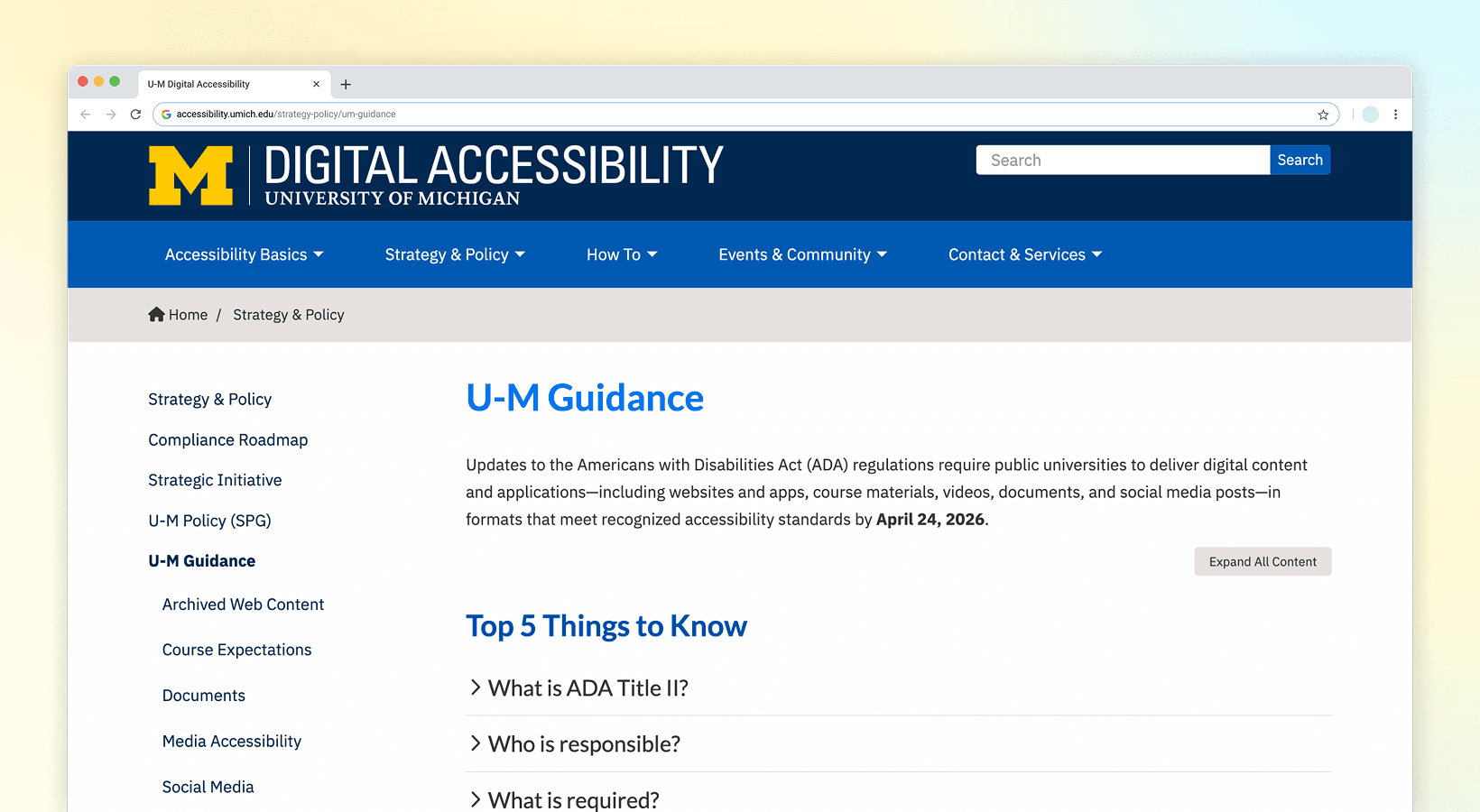
U-M Digital Accessibility website showing current ADA Title II guidance.
Discovery
I was remediating slides alongside faculty every week and started tracking how long it actually took.
The math didn't work. A single faculty member would need 30+ hours just to remediate one semester of slides, on top of their typical teaching load.
A 40-slide lecture deck averaged ~90 minutes of manual fixes, and many professors had 30+ decks per course.
Faculty were overwhelmed.
Professors understood why accessibility mattered but couldn't justify the time cost against their teaching responsibilities.
The bottleneck was simple, repetitive fixes.
Many flagged issues were predictable and mechanical such as missing slide titles or insufficient contrast ratios.
The existing tool, Grackle, could flag issues but couldn't fix them, and each flagged issue had to be corrected by hand.
Screen recording of the Grackle accessibility extension in Google Slides.
First Attempt
My initial solution was a standalone web app.
Faculty would upload a Google Slides link, the tool would scan and remediate, and they'd get a fixed version back.
Screen recording of the standalone web app remediation tool.
Pivot
I rebuilt the tool as a Google Apps Script extension via a sidebar panel that lives directly inside Google Slides.
The decision to move into the native environment changed adoption from "a new tool I have to remember to use" to "a button that's already there."
How It Works
The extension mirrors Grackle's audit parameters so faculty see familiar issue categories, then adds an auto-fix layer on top.
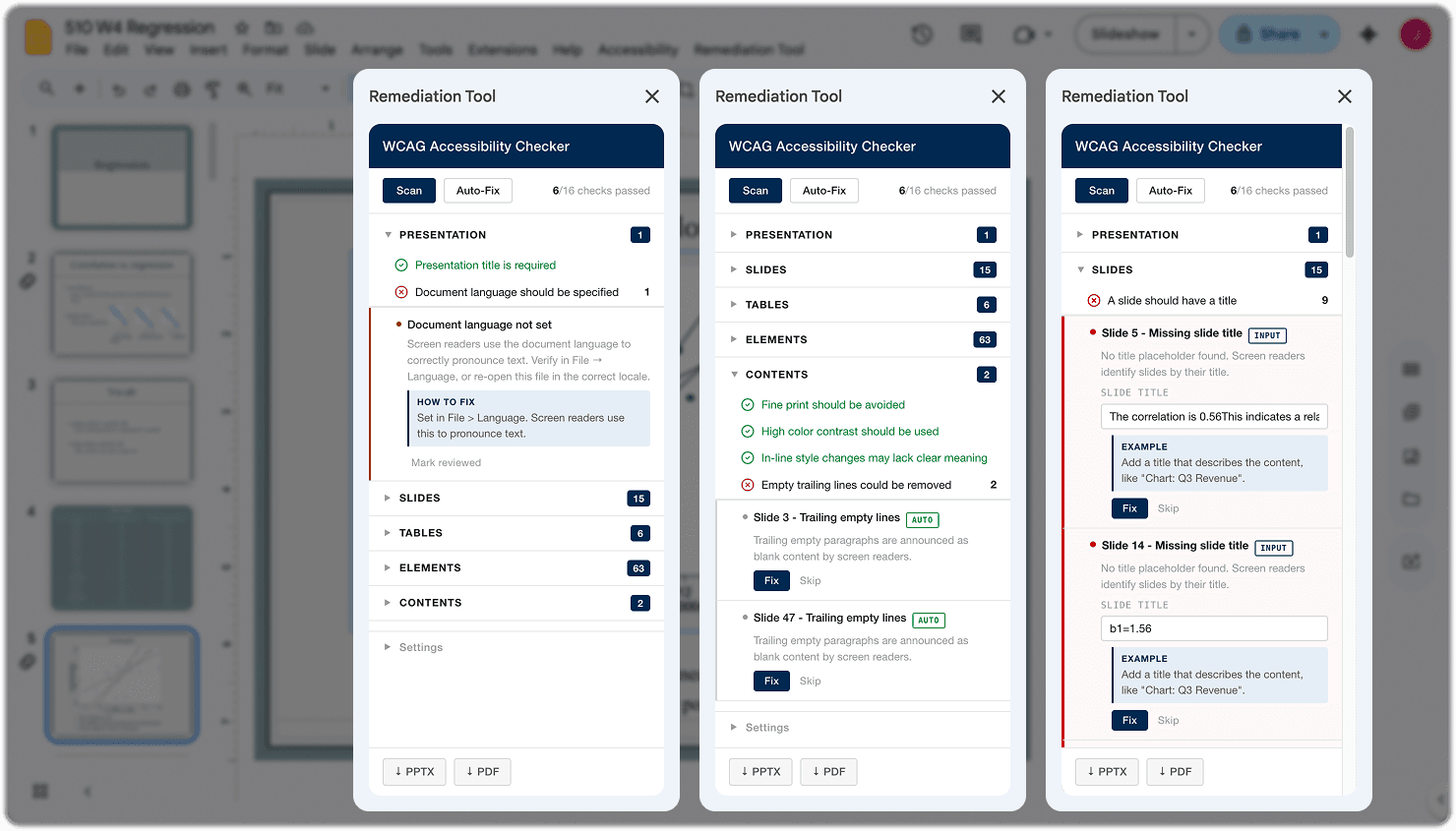
Google Apps Script extension Variants
Screen recording of the Google Apps Script extension running inside Google Slides.
Impact
A 45-slide deck that previously took ~90 minutes to remediate now takes ~20 minutes, with most of that time spent on issues that require human judgment.
"I went from dreading this to doing it between meetings."
— Sociology faculty member

Next Steps
The extension only runs on personal Google accounts due to U-M's restrictions on unapproved third-party scripts.
Two things need to happen for this to scale:
Security approval
Working with LSA Tech Services to get the extension approved for use on university Google Workspace accounts so any faculty member can install it.
U-M Maizey Integration
U-M's internal AI tool, Maizey, could generate alt text for images and slide titles based on content, eliminating more time-intensive manual fixes and avoiding external API costs & data privacy concerns.
Reflection
The biggest lesson was that a viable solution can still be the wrong shape.
The web app solved the right problem in the wrong place. Rebuilding as a native extension was a design decision about where faculty attention actually lived. The best tool is the one that doesn't ask users to change their behavior.
Next Project

PlaySmart
Scaling a coaching platform to 35+ schools and 300+ athletes.
Founding Design
AI Features
Startup
Contact me: jusmas@umich.edu